The Butterfly Effect Studio for Training

Embrace Your Metamorphosis

Walter Sellers is a 25-year health and fitness veteran, founder of Classicman Fitness, and the driving force behind The Butterfly Effect Studio for Training. With a degree from Elon College and a rich background in retail automotive and management consulting, Walter brings a unique blend of business savvy and heartfelt leadership to the wellness industry.

He is certified through ISSA, Action CPT, and Girls Gone Strong (GGS1), with advanced specializations in women’s health, group fitness, and pre/postnatal training. Walter is also a proud graduate of the Streetwise MBA program, equipping him with advanced business leadership and strategic growth expertise.

Walter’s passion for fitness is matched only by his accomplishments in the sport. He is a professional powerlifter and bodybuilding competitor, holding multiple national and world records across the WNPF, NPL, APA, and RPS (Revolution Powerlifting Syndicate) federations. As a drug-free world record holder, his dedication to integrity and excellence is at the heart of everything he does.

Beyond the gym, Walter is committed to creating safer, more empowered communities. He is a certified “train the trainer” facilitator for A CALL TO MEN, through the Delaware Alliance Against Sexual Violence, empowering him to lead transformative workshops focused on respect, consent, and understanding.

Walter has coached teams to regional, national, and world records, and is known for his empathetic, family-minded leadership style. Under his guidance, The Butterfly Effect Studio for Training has become Delaware’s premier private wellness studio, dedicated to empowering women and families to achieve lasting transformation—mind, body, and spirit. 🦋💪🌟
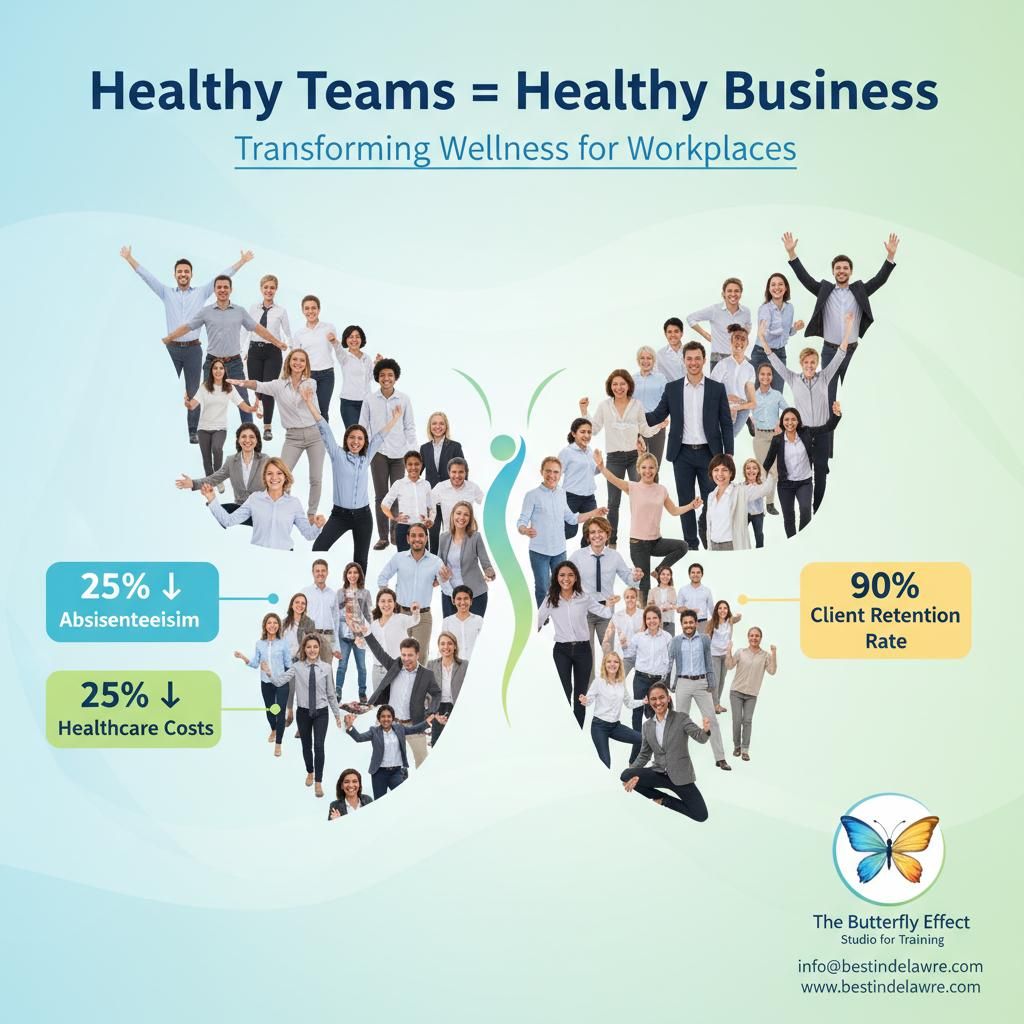
Why Healthy Employees Help Your Business Thrive: Workplace Wellness and the Bottom LineWhen you think about your business’s most valuable assets, what comes to mind? Your technology? Your facilities? Your brand reputation? While these are all important, there’s one asset that drives everything else: your people. And when those people are healthy, engaged, and energized, the impact on your bottom line is nothing short of transformational.The conversation around workplace wellness has shifted dramatically in recent years. What once was considered a “nice-to-have” perk has become a strategic business imperative. Companies are discovering that investing in employee health creates a ripple effect that strengthens every aspect of their operations—from productivity and retention to healthcare costs and competitive positioning.The Numbers Don’t Lie: Workplace Wellness Delivers Real ROILet’s cut straight to what matters most to business leaders: return on investment. The data surrounding workplace wellness programs is compelling, with companies experiencing a 2.5x return on investment from improved productivity and reduced absenteeism. Even more impressive, 95% of companies report seeing positive returns from their wellness initiatives.The investment payoff typically ranges from $1.50 to $3.00 for every dollar spent, with benefits accumulating over a 2 to 9-year timeframe. Consider Johnson & Johnson’s remarkable success story: their comprehensive wellness program has cumulatively saved the company $250 million in healthcare costs over the past decade, generating a return of $2.71 for every dollar invested.These aren’t just feel-good statistics—they represent real money flowing back to your bottom line. With the average company now investing $650 per employee per year in wellness-related benefits, the question isn’t whether you can afford to implement a wellness program, but whether you can afford not to.Productivity Gains That Transform Your BusinessHealthy employees are productive employees. When wellness programs address the daily distractions that impact focus—health issues, stress, financial worries—employees gain the energy and mental clarity needed to perform at their peak.More than 90% of business leaders surveyed confirm that promoting wellness improves employee productivity and performance. This belief is backed by concrete results: studies show that both healthy and previously unhealthy individuals increase their productivity by approximately 10% when participating in corporate wellness programs.The productivity benefits extend beyond individual performance improvements. Organizations with wellness initiatives experience a 20% boost in overall employee productivity, while 31% of employees report that wellness programs help them focus better at work.Think about what a 10-20% productivity increase means for your business. If you have 100 employees earning an average of $50,000 annually, that productivity boost represents hundreds of thousands of dollars in additional value creation—far exceeding the cost of most wellness programs.Strategic Cost Reduction Across Multiple AreasHealthcare Cost ManagementOne of the most immediate and measurable benefits of workplace wellness is healthcare cost reduction. 59% of businesses report lower healthcare costs after implementing wellness programs, demonstrating how preventive health measures reduce expensive medical interventions down the line.Johnson & Johnson’s experience illustrates this perfectly. Since launching their wellness program in 1995, the percentage of employees who smoke has dropped by more than two-thirds, while those with high blood pressure or leading sedentary lifestyles has declined by more than half. These behavioral changes translate directly into reduced insurance premiums and lower healthcare utilization.Absenteeism ReductionSick days represent a hidden cost that many businesses underestimate. Beyond paying for unused work time, absenteeism disrupts workflows, delays projects, and forces other employees to pick up additional responsibilities.Wellness programs effectively combat this challenge. More than half of employers offering wellness programs report decreased absenteeism, while 56% of employees say they use fewer sick days as a result of participating in wellness initiatives.Consider the math: if an employee earning $50,000 annually misses 10 days per year due to preventable health issues, that’s nearly $2,000 in lost productivity per person. Multiply that across your entire workforce, and the savings potential becomes substantial.Building a Magnetic Workplace CultureIn today’s competitive talent market, wellness programs have become essential for attracting and retaining top performers. 83% of employers categorize their wellness program as ‘very’ or ‘extremely’ important to talent acquisition, while wellness-focused workplaces report 24% higher employee satisfaction rates.The retention benefits are particularly strong among younger workers who prioritize work-life balance. 91% of Gen Z employees consider wellness programs non-negotiable in their job search, while 78% of millennials say wellness initiatives improve their loyalty to their employer.This matters because turnover is expensive. Research suggests that burnout contributes to up to 50% of workforce turnover, and the cost of replacing a single employee ranges from half to twice their annual salary. Wellness programs can pay for themselves simply by reducing turnover rates.Creating Lasting Behavioral ChangeEffective wellness programs don’t just provide temporary fixes—they create lasting lifestyle changes that benefit both employees and organizations long-term. 73% of wellness program participants report making healthier lifestyle choices as a result of their participation, indicating that these initiatives successfully promote sustainable improvements.The social aspect of wellness programs amplifies their effectiveness. 49% of employees say peer encouragement drives their engagement with wellness initiatives, creating a positive workplace culture where healthy behaviors are reinforced and celebrated.This peer-to-peer motivation transforms your workplace environment, creating an upward spiral where healthy habits become the norm rather than the exception.Measuring Success: Wellness as a Business MetricForward-thinking companies are integrating wellness metrics into their core business measurements. 46% of executives now include wellness metrics in company KPIs, reflecting the recognition that employee wellness directly impacts business performance and should be tracked alongside traditional financial indicators.The widespread adoption speaks volumes: 87% of companies now have formal wellness programs in place, up from just 61% in 2020. This dramatic increase demonstrates that organizations across industries recognize wellness as a competitive necessity.Most tellingly, U.S. businesses with comprehensive wellness programs experienced a 63% leap in financial growth, highlighting how these strategies contribute to overall organizational success beyond just cost savings and productivity gains.Getting Started: Your Path to Wellness ROIThe beauty of workplace wellness is that you don’t need to implement everything at once. Start with initiatives that address your employees’ most pressing needs—whether that’s stress management, physical fitness, nutrition education, or mental health support.Consider partnering with fitness professionals who understand the unique challenges of corporate wellness. The right partnership can help you design programs that fit your culture, budget, and goals while maximizing employee engagement and business results.Remember, the goal isn’t to become a healthcare provider—it’s to create an environment where your people can thrive. When employees feel supported in their health and wellness journey, they bring their best selves to work every day.Your investment in employee wellness isn’t just about being a good employer—it’s about being a smart business leader who recognizes that healthy employees are the foundation of a thriving, profitable organization.Ready to explore how corporate wellness can transform your business? Let’s start a conversation about building a healthier, more productive workplace that drives real results for your bottom line. Discover our corporate wellness partnership programs and take the first step toward unleashing your team’s full potential.

Posted in

Leave a comment